



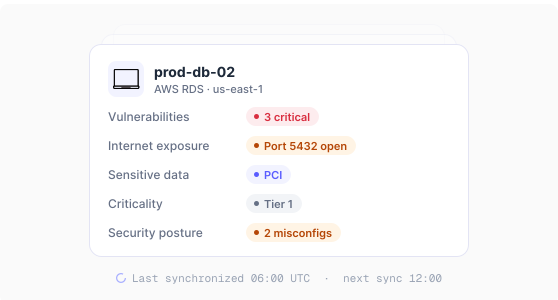
Scheduled enrichment
For context that changes relatively slowly:
Aleph keeps this information synchronized and ready for detection without querying external systems for every event.
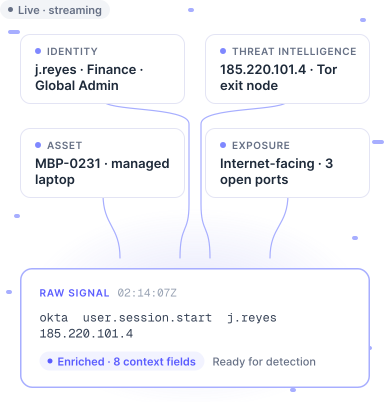
Aleph brings real-time context into every security signal before detection decides what matters, so teams catch more, reduce noise, and investigate faster.
See It in Action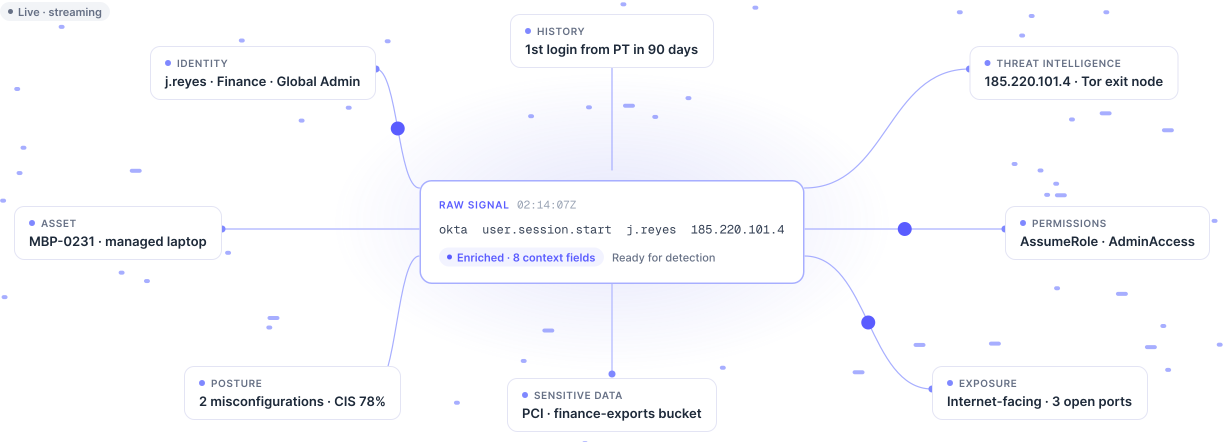
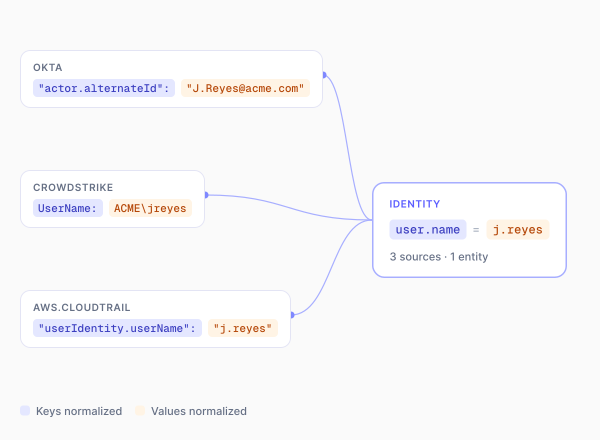
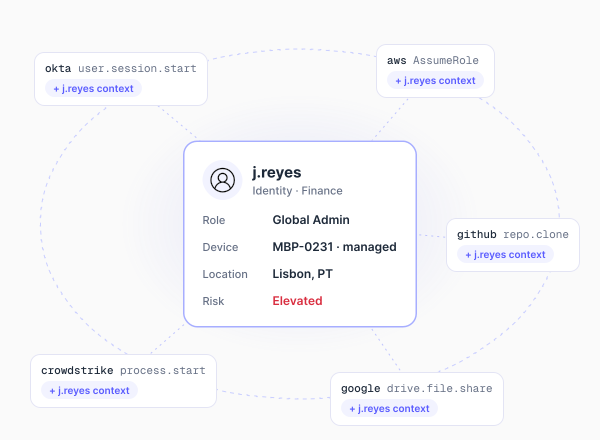
Aleph parses, normalizes, and maps incoming data into a common security language, so every identity, asset, and resource is recognized consistently across sources.
Aleph does not rediscover the same context for every event.
It continuously builds an internal representation of the environment and makes that context reusable across incoming security data. That means fewer repeated lookups, less dependency on third-party APIs, and context that can remain available even at millions of signals per second.

Some context can be synchronized periodically.
Other context can become wrong within seconds.
Aleph supports both by design.
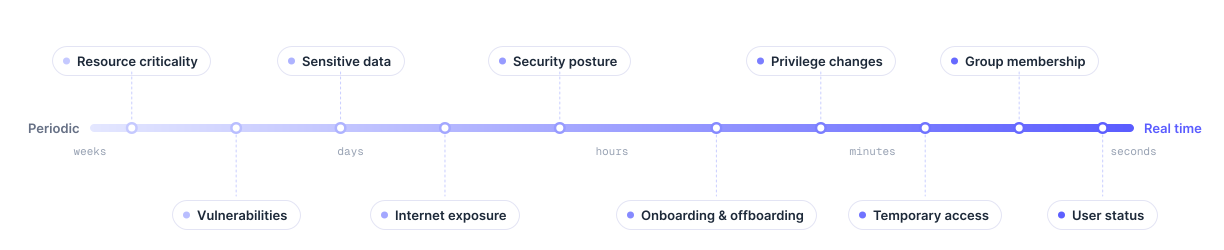
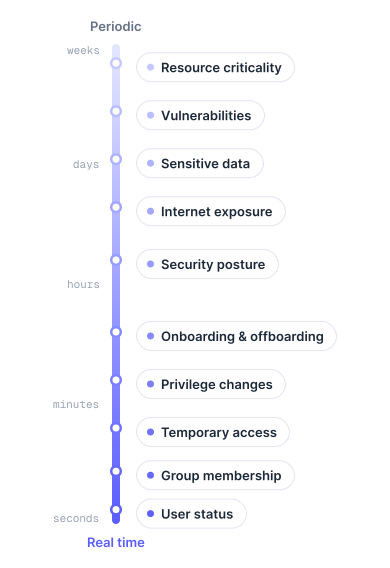
For context that changes relatively slowly:
Aleph keeps this information synchronized and ready for detection without querying external systems for every event.
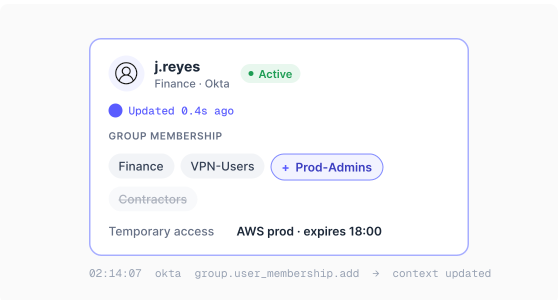
For context where freshness can change the security decision:
When that state changes, Aleph can update the context with it instead of waiting for the next scheduled sync.
This is the fundamental difference. If enrichment begins after an alert fires, it can help explain the alert. When enrichment is available before detection, it becomes part of the detection logic itself.
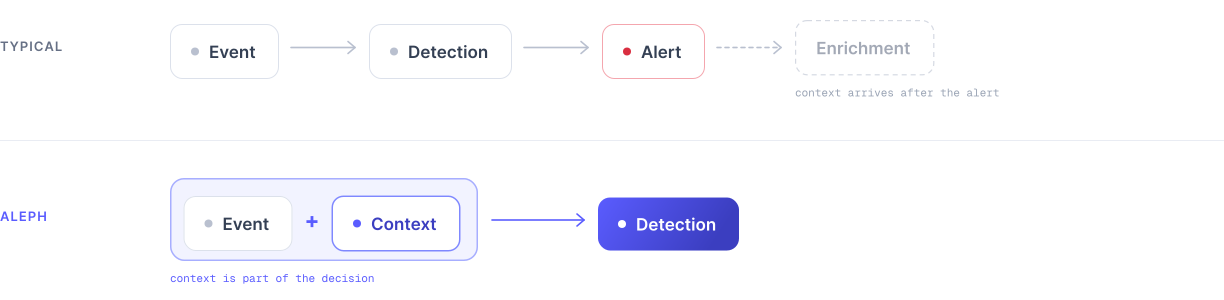
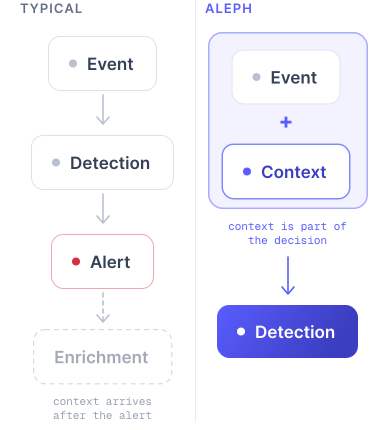
Without context, these signals stay disconnected until investigation. With Aleph, they become part of the detection decision itself, helping determine whether an alert should fire and how urgently it should be handled.
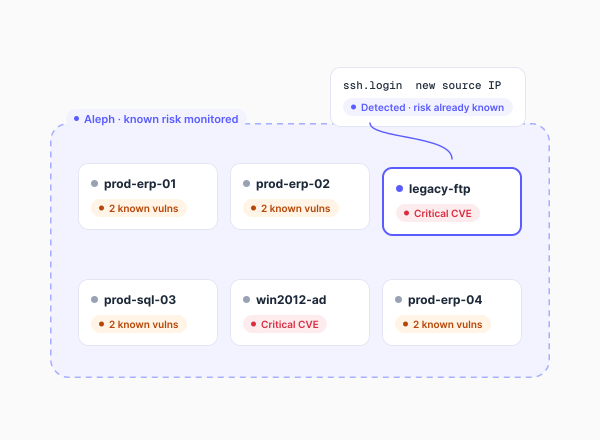
Not every vulnerability can be fixed immediately.
Legacy systems remain in production. Patches wait for maintenance windows. Business priorities delay remediation.
Aleph keeps the existing risk context available, so unexpected activity around those assets can be detected with the risk already understood.
Known risk becomes monitored risk.
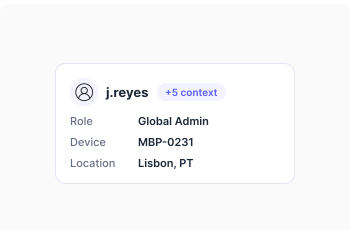
ENRICHMENT
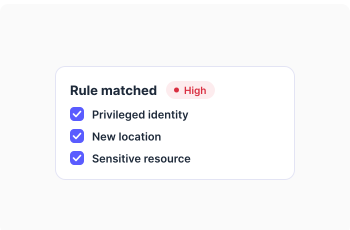
DETECTION
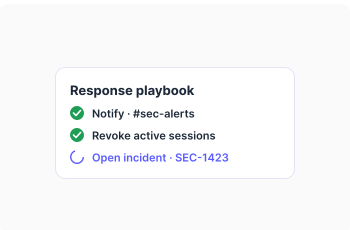
WORKFLOW
Notify an owner. Open an incident. Contact a user. Trigger remediation. Update another security system.
Workflows remain valuable. Aleph simply uses them where orchestration adds value, rather than as the infrastructure required to understand every event.
Repeated workflow executions and paid enrichment APIs become increasingly expensive as event volume grows.
Aleph reduces unnecessary calls through centralized context, caching, correlation, reuse, and policy controls.
In one customer environment, moving high-volume enrichment and data handling into Aleph reduced annual workflow-engine spend from approximately:
$500K$50K
Annual workflow-engine spend
The workflow platform remained in place. It was used for orchestration instead of high-volume data processing.
<1 second
Event to detection
1M+
Signals analyzed and enriched every second
95%
Fewer false positives
with full context

"Before Aleph, critical context was spread across different systems. Now we get a much clearer picture around every event. Aleph's enrichment brings the missing context together and makes investigations faster and more complete."
Nir R.
CISO
30%
decrease in first reply time
+10%
annual increase in NPS
In traditional SIEM and workflow-based architectures, enrichment is often performed after detection or through separate processes that query external systems for additional context.
Aleph brings that context into the security data layer itself, so identity, asset, posture, exposure, permissions, sensitive data, threat intelligence, and historical context can be available before detection makes a decision.
This turns enrichment from an investigation aid into part of the detection logic itself, enabling more precise detections, better prioritization, fewer false positives, and significantly less manual context gathering.
Some security context can become outdated within seconds. User status, group membership, temporary access, privilege changes, and onboarding or offboarding state are all examples.
Aleph can update this context as the underlying state changes rather than waiting for the next scheduled synchronization.
That matters because stale context can lead to both false positives and missed detections. Security decisions should reflect the environment as it exists now, not as it appeared several hours earlier.
No. The appropriate update model depends on the type of context.
Vulnerability data, internet exposure, sensitive-data classification, asset criticality, and posture can often be synchronized periodically and reused efficiently. Identity and access state may require much faster updates.
Aleph supports both models, keeping context fresh where freshness materially affects the security decision without introducing unnecessary cost or complexity elsewhere.
Aleph parses and normalizes incoming data, including both keys and values, and identifies the entities represented within it.
Users, assets, IPs, IAM roles, applications, servers, buckets, tenants, and other entities can then be recognized consistently across different sources.
This creates a common security language across the environment, allowing context to follow the entity wherever it appears.
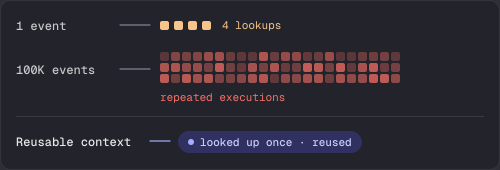
The same identity, asset, or resource appears repeatedly across the environment.
Aleph can build context around that entity once and reuse it across relevant events instead of repeatedly querying external systems for the same information.
That improves consistency, reduces third-party API calls, and makes rich enrichment practical even at millions of signals per second.
It allows detection logic to evaluate the security meaning of an event, not only the event itself.
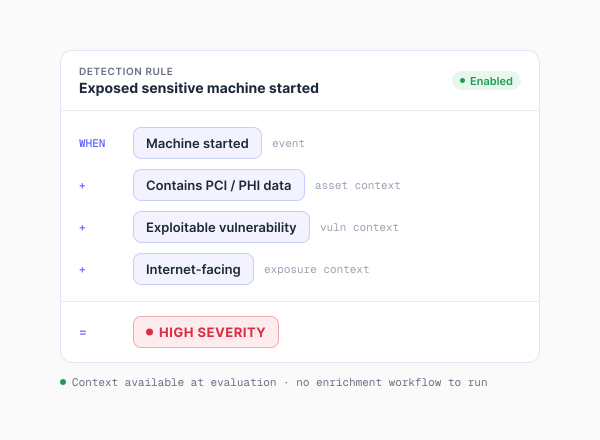
A machine starting may be unremarkable. A production machine starting while internet-facing, vulnerable, and holding sensitive data can require immediate attention.
Making those combinations available directly to the Detection Engine enables higher-confidence alerts, better severity decisions, and detections that isolated event rules could otherwise miss.
Yes. A vulnerability alone rarely provides enough information to determine priority.
Its significance changes based on exposure, exploitability, sensitive data, business criticality, and current activity around the asset.
Aleph makes that context available to detection and severity logic, helping teams distinguish lower-priority findings from situations that require immediate attention, while also monitoring risks that cannot be remediated immediately.
Workflows are highly effective for orchestration, but less efficient as the underlying infrastructure for enriching every security event.
At high volume, repeated calls to third-party systems introduce latency, API limits, duplicated lookups, additional workflow executions, and significant cost.
Aleph handles synchronization, caching, normalization, vendor constraints, reuse, and policy logic within the enrichment layer itself. Workflows can then be reserved for orchestration once something meaningful has been detected.
The impact depends on event volume, external APIs, and how much enrichment is currently performed through workflows.
In one customer environment, moving high-volume enrichment and data handling into Aleph reduced annual workflow-engine spend from approximately $500K to $50K.
The workflow platform remained in place, but was used for orchestration rather than high-volume security data processing.
Yes.
Aleph can work with identity, cloud, posture, security, SaaS, internal applications, databases, business systems, and other organization-specific sources.
Where a standard integration is not enough, custom integrations, parsers, and enrichment logic can be built. Where full ingestion is unnecessary or uneconomical, additional context can also be retrieved selectively when a specific investigation or use case requires it.
Once Aleph understands an identity, asset, or resource, the same context can improve detection, severity, suppression, investigation, and response across the platform.
That is the broader advantage of treating enrichment as shared security infrastructure rather than a one-time lookup attached to an individual alert.
Aleph turns your security data into enriched answers, clear investigations, and coordinated action.
Book a demo